
Quick verdict: if you edit mainly on a phone, the Insta360 X6 is the easier camera to recommend today. Its advantage is the editing workflow, not a proven lead in image quality. The DJI Osmo 360 II makes more sense if you can buy it with local support and actually need 8K60, high-frame-rate 4K, a lighter body or more internal storage. No matched source-file test has produced an overall image-quality winner.
The choice goes well beyond 8K60 versus 8K50. You will live with the app, file format, lens-repair process and accessory system long after the launch videos disappear from your feed. Regional availability matters too: a lower price means little if warranty service or replacement parts are hard to obtain where you live.
This article interprets creator footage and user reports. For a specification-by-specification comparison that also includes GoPro MAX2, see Insta360 X6 vs DJI Osmo 360 II vs GoPro MAX2.
One rule for reading this comparison:
- Declared by the manufacturer: a specification or workflow documented by Insta360 or DJI.
- Reported by users: an observation from Reddit or YouTube comments; useful as a qualitative signal, not proof.
Insta360 X6 vs DJI Osmo 360 II: comparison at a glance
Start with the differences you can verify. The final row is just as important as the headline numbers.
| Decision point | Insta360 X6 | DJI Osmo 360 II | Verification status |
|---|---|---|---|
| 360 video maximum | 8K up to 50 fps | 8K up to 60 fps | Manufacturer specification |
| 360 slow motion | 4K up to 100 fps | 4K up to 240 fps | Manufacturer specification |
| Maximum stated video bitrate | 240 Mbps | 220 Mbps; 600 Mbps applies only to 16K 360 timelapse | Manufacturer specification |
| Sensor format | Two custom Sony 1/1.1-inch square sensors | Two 1/1.1-inch square CMOS sensors | Manufacturer specification |
| Aperture | f/2.0 | f/1.9 | Manufacturer specification |
| Log workflow | 10-bit I-Log | 10-bit D-Log M | Manufacturer specification |
| Native 360 file | INSV | OSV | Manufacturer specification |
| Built-in storage | 64 GB, 47 GB usable | 128 GB, 105 GB usable | Manufacturer specification |
| Battery capacity | 2,600 mAh | 2,150 mAh | Manufacturer specification; runtime is not comparable from capacity alone |
| Weight | 196 g | 183 g | Manufacturer specification |
| Native waterproof rating | 20 m | 10 m | Manufacturer specification; underwater stitching needs separate evaluation |
| Replaceable outer lenses | Yes | Yes | Manufacturer specification |
The Osmo 360 II entries were re-verified on August 18, 2026. DJI's own specification page still returns a 404 outside China and Hong Kong — the Osmo 360 II is currently a China/Hong Kong-only launch, and DJI has not published a global product or specs page yet. International availability is reportedly expected by the end of September 2026, based on DJI's rollout pattern for prior Osmo products. In the absence of a live official page, every row above was cross-checked against two independent outlets that cite DJI's own press materials from the launch — Geeky Gadgets and RedShark News — and the numbers matched across both.
These numbers describe recording options, not how good the finished video will look. More frames help with fast motion and slow motion, but they also create more data and usually demand more light. A slightly wider aperture does not settle low-light quality. Bitrate alone says nothing about sharpening, noise reduction or a bad stitch across someone's face.
The native file extensions matter after recording. Insta360 uses INSV and DJI uses OSV for their proprietary camera output; these are not interchangeable merely because both cameras record a 360-degree scene. The Mirame360 guide to 360 video formats and spherical metadata explains the difference between camera files, stitched equirectangular masters and browser-ready delivery files.
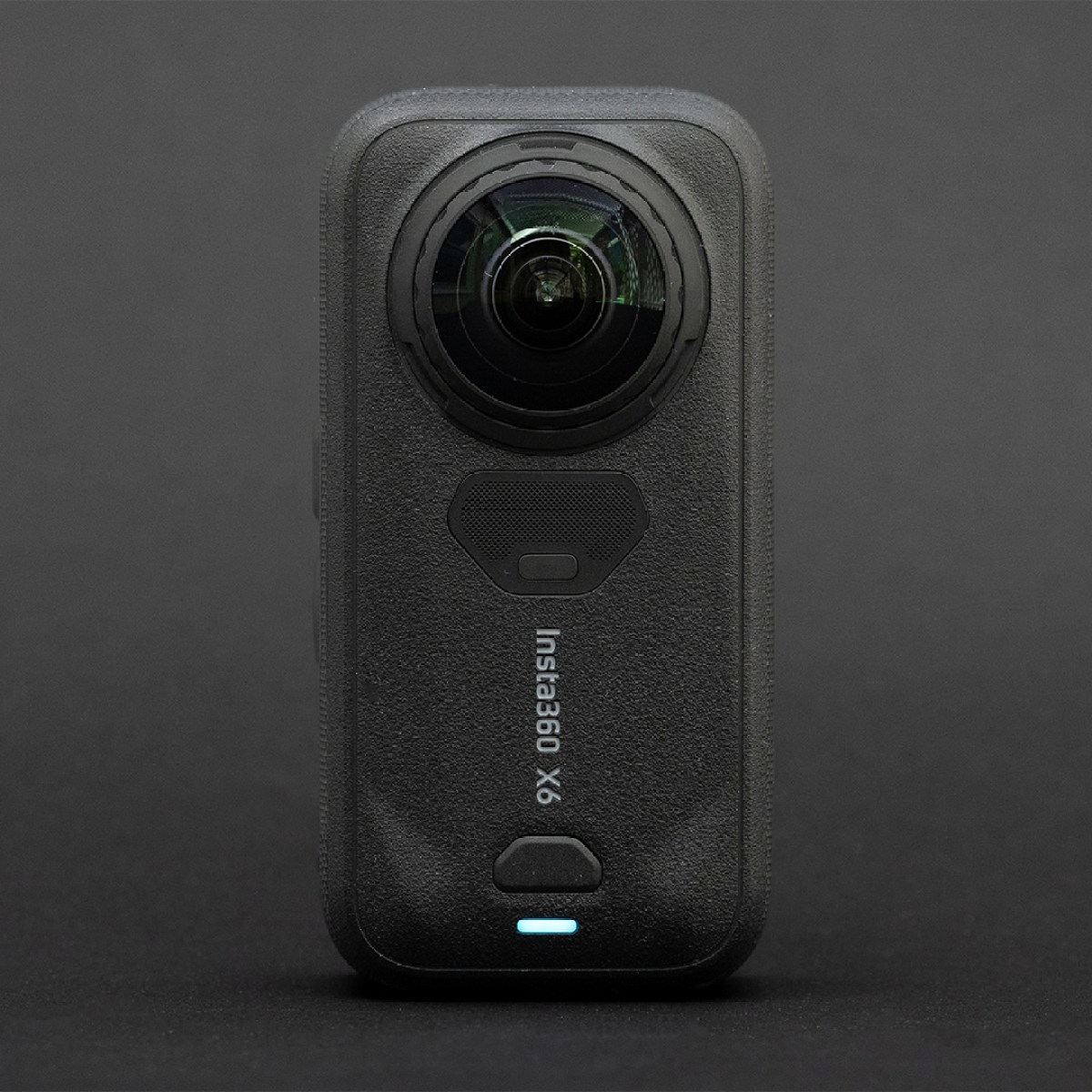
Insta360 X6 product image from the existing Mirame360 media library.
Why software keeps coming up on Reddit
Ask Reddit why someone would pay more for the X6 and the answer keeps coming back to editing. Not everyone loves Insta360's software, but several people in the discussion below say it gets them from a 360 clip to a finished social video with less friction. For this kind of camera, that matters. Recording is only half the job; you still have to choose the view, track a subject, add keyframes and export a flat video.
Read the r/360Cameras discussion
A second thread makes the trade-off more concrete. The buyer has an iPhone 15 Pro Max and an old laptop, and wants tracking, reframing and a normal-looking flat export. For that person, app speed and usable tracking matter more than ten extra frames per second at 8K. Someone finishing in Final Cut Pro or DaVinci Resolve may reach the opposite conclusion.
Read the mobile-app workflow discussion
Reported by users: Insta360's app and desktop workflow are usually described as the more mature option. That is a community opinion, not a benchmark. Nobody in the cited threads publishes matched export times, crash rates or tracking success data. A useful test would run the same reframe on the same phone, then compare processing time, output bitrate, file size and visible quality. This has not been tested by Mirame360.
Does 8K60 make the Osmo 360 II the automatic winner?
No. DJI's 8K60 mode is a real advantage on the specification sheet, but plenty of buyers will never use it.
It makes sense for motorcycles, skiing, cycling and other fast movement, especially if you want to slow the result on a 30 fps timeline. It is much less persuasive for real-estate walkthroughs, travel panoramas, virtual-tour stills or ordinary 24/25/30 fps delivery. Sixty frames per second also needs enough light to keep the shutter speed useful. The mode can be better on paper and noisier in the scene you actually shoot.
And remember what “8K” describes here: the whole sphere. A reframed view uses only a slice of those pixels, so an 8K 360 recording does not produce an 8K flat crop.
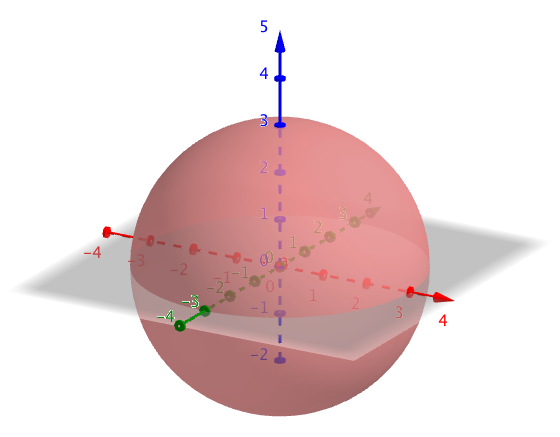
A 360 capture describes directions around a sphere; a reframed view uses only part of it. Illustration by Bert Niehaus, CC BY-SA 4.0, hosted locally without modification.
What the first direct YouTube comparisons show
Two recent videos put the actual cameras on screen. That already makes them more useful than the many “comparisons” built from product photos and spec sheets. Watch them for handling, default rendering and the questions they raise, not for a laboratory verdict.
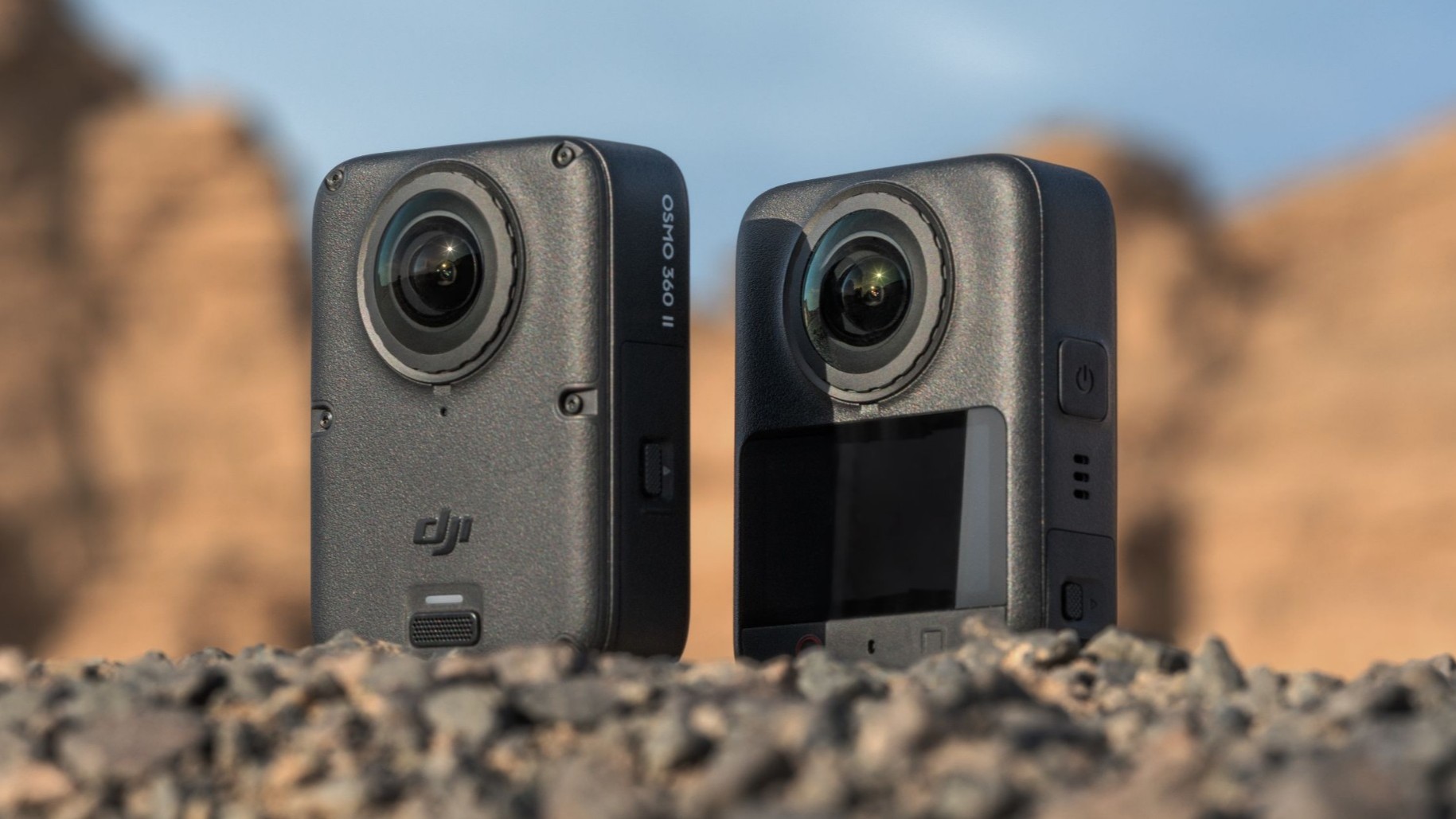
DJI Osmo 360 II product image from the existing Mirame360 media library.
Kingmi Mobile: broad hands-on comparison
This is the broader of the two videos. In 10 minutes, Kingmi Mobile shows both bodies, compares features, points a thermal camera at them and includes footage from different lighting conditions.
What viewers are saying
The comments are less interested in declaring an image-quality winner than the video title might suggest. DJI gets credit for its usable internal storage and aggressive specifications. The X6 gets hammered on price. Yet some viewers still choose it, including people who already own DJI gear, because they prefer Insta360's app and the slimmer body for a motorcycle mount or selfie stick.
The unanswered questions are revealing. When can people buy the DJI model and its accessories outside the initial markets? Where are the matched crops that show fine detail at the same scale? If viewers still have to ask which camera has better image quality after watching, the upload has not settled that question. Comments reviewed August 18, 2026; they are individual reactions, not a representative survey.
Watch this video for:
- both named camera bodies are visibly present;
- the creator performs a physical temperature check;
- viewers can inspect the creator's edited examples and handling observations.
Do not use it to conclude:
- that both cameras used matching firmware, exposure, color profile and stabilization settings;
- that the temperature segment began with equal battery state, ambient temperature and recording duration;
- that the compared clips passed through equivalent stitching and export settings;
- that YouTube's transcode preserved small detail equally.
The thermal segment is interesting, but without equal starting conditions it is not a thermal benchmark. The same caution applies to image quality.
Invisible Tech: synchronized split-screen footage
This one is only three minutes long and easier to scan. The split screen labels each side and moves through outdoor scenes with foliage, grass and bright highlights. It shows how this particular upload renders; it does not show what the native files contain.
What viewers are saying
There are only a handful of comments, and they do not agree. One viewer sees almost identical shadow detail and asks for a night test in a city. Another calls the X6 more natural and the DJI image too saturated. A more skeptical viewer thinks the cameras or labels may have been swapped during the edit. Several people simply want moving low-light footage and a real release date.
That disagreement is the point. People can see a difference, but the video does not reveal whether it came from exposure, a color profile, the cameras themselves or the edit. A stronger comparison would show the settings, keep both cameras visible during recording and provide the files. Comments reviewed August 18, 2026.
The description leaves out firmware, frame rate, exposure, ISO, shutter speed, color profile, stitching software and export bitrate. With none of that information, the video cannot prove sensor-level dynamic range, resolving power or a universal color advantage.
Reddit users are asking for the same missing evidence. In the thread below, people complain that search results are crowded with low-provenance or apparently synthetic comparisons, then point to the Kingmi video as one of the few direct examples worth discussing.
Read the direct-comparison request on Reddit
Low light, exposure and color: what can be said now
Color debates start quickly and rarely end well on YouTube. In these videos, some viewers prefer the X6's rendering; others like DJI's brighter result. That tells you what people enjoy looking at, not how many stops of dynamic range either camera records.
YouTube also changes the evidence. Its transcode can soften leaves, add blocking during movement and treat two uploads differently if their masters were exported with different settings. A serious low-light comparison needs the stitched master and, ideally, the native camera files. Then you can compare:
- matched shutter speed, ISO limit and white balance;
- standard, HDR and log modes separately;
- temporal noise reduction and motion smearing;
- highlight clipping and recoverable shadow detail;
- local master versus YouTube transcode.
Until someone publishes that material, “better in low light” remains unverified.
Stitching and edge sharpness
Stitching is not one score. Put a face too close to either camera, let an arm cross the seam or add a lens protector, and the result can change immediately. A sharp crop from the middle of one lens says nothing about the seam. One ugly seam in one clip does not prove that a camera always stitches badly.
DJI's documentation captured during research gives 0.75 m as the safe minimum distance for the bare camera. That number matters when a hand, handlebar or face sits close to the lenses. Any useful comparison should put the same object at measured distances from both cameras instead of waving a selfie stick around and calling the result scientific.
120MP photos, RAW and 16K timelapse
“120MP” looks decisive in a product table. It is not. A huge JPEG can still contain smeared detail, heavy noise reduction or stitch errors, and none of those problems shows up in the pixel dimensions. DJI also documents RAW support and a 16K timelapse mode, but the useful questions are file size, processing time and what survives when the image is viewed in a headset or virtual tour.
The Reddit thread below asks for exactly those details: source files, processing time, compression, interval limits and real 120MP output. One person describes an in-store look at the Osmo 360 II. Another compares the X6 with the original Osmo 360, not the II. They are useful leads, but they are not the same comparison.
Read the 120MP and 16K timelapse discussion
Without downloadable JPEG and RAW/DNG files, there is little more to say. The eventual test should include file sizes, capture-to-ready time, tripod and handheld scenes, moving subjects, bright windows in dark interiors and headset viewing. That comparison has not been performed.
Tracking and mobile-first editing
A tracking demo with one person walking through an empty frame tells you very little. The harder case is two people crossing. One r/Insta360 user says X6 InstaFrame switches between an adult and a nearby child. That is one report, not a failure rate, but at least it gives reviewers a test they can repeat.
Read the X6 InstaFrame tracking report
Record one, two and three people crossing at different distances. Use the same phone, current public apps and current firmware. Count incorrect switches and manual corrections, then time the export. Until that happens, “reliably better tracking” is advertising or anecdote, not a result.
Replaceable lenses and underwater use
Replaceable outer lenses are good news. Fisheye glass sticks out and scratches easily. But “replaceable” does not mean the same thing on both cameras: check the price, required tools, calibration steps, dust risk and whether the camera remains waterproof after the repair.
Underwater use deserves its own comparison. The X6 store offers a 60 m dive-case bundle with dedicated underwater lenses. DJI's previously captured documentation listed an optional 50 m case. Reddit users are less interested in those maximum depths than in the awkward details: the X6 lens swap, focus through the housing and whether the stitch still holds underwater.
Do not buy either setup for diving from the depth number alone. Check underwater focus, stitching, buoyancy, the lens-change process and whether the case is actually in stock.
Availability, warranty and regional support
The best camera is useless if you cannot buy it with a real warranty. The X6 was listed on Insta360's Italian store when this article was checked. DJI Osmo 360 II availability is genuinely limited right now, not just hard to find: the camera has only launched in China and Hong Kong, and DJI's regional 360-2 page still returns a 404 outside that market as of August 18, 2026. People on Reddit and YouTube were still asking about Europe and other markets at the time of writing.
The camera may be on sale elsewhere, but a gray-market listing is not an official launch. Before comparing prices, confirm the authorized seller, warranty coverage, return route, replacement-lens stock and app availability in your country.
- Check the Insta360 X6 official store
- DJI Osmo 360 II launch specs and pricing (Geeky Gadgets) — DJI's own product page is not yet public outside China/Hong Kong
- DJI Osmo 360 II China launch and pricing (RedShark News)
Which camera is the better fit for your workflow?
There is no honest overall winner yet. The choice becomes much easier once you name the job.
| Requirement | Better fit today | Why | Evidence basis |
|---|---|---|---|
| Phone-first reframing and fast social publishing | Insta360 X6 | Users repeatedly prefer the Insta360 editing workflow | User reports; comparative speed and reliability have not been independently tested |
| 8K capture above 50 fps | DJI Osmo 360 II | DJI lists 8K60; X6 reaches 8K50 | Manufacturer specification |
| High-frame-rate 360 capture | DJI Osmo 360 II | DJI lists the stronger 4K high-frame-rate mode | Manufacturer specification |
| More usable internal storage | DJI Osmo 360 II | 105 GB versus 47 GB stated as usable | Manufacturer specification |
| Lower camera-body weight | DJI Osmo 360 II | 183 g versus 196 g | Manufacturer specification |
| Official purchase and support in the buyer's region | Depends on region | Availability and warranty routes vary | Check authorized local channels before purchase |
| Proven low-light, stitching or thermal superiority | Neither | No matched native-file benchmark was available | Not established by testing |
Pick the Insta360 X6 if most of your editing happens on a phone, you already depend on Insta360's ecosystem or it is the only model with straightforward local support. You are choosing the workflow, not proven superior image quality.
Pick the DJI Osmo 360 II if an authorized seller supports it in your region and 8K60, high-frame-rate 4K, lower weight or 105 GB of usable internal storage will change how you shoot. Those are real specification advantages. They do not prove that every clip will look better.
If low light, stitching, heat, log grading, 120MP stills or underwater sharpness will decide the purchase, wait. The current YouTube uploads are not strong enough evidence.